Le paysage des générateurs de musique par IA a fini par se stabiliser, en 2026, d’une manière qui aurait semblé improbable il y a deux ans à peine. Suno et Udio, les deux noms qui concentraient l’essentiel des procès pour violation de droits d’auteur, ont réglé l’essentiel de leurs litiges et signé des accords de licence avec plusieurs majors — ce qui ne veut pas dire que le sujet est clos, seulement qu’il a changé de nature : d’une zone grise juridique, on est passé à un marché normalisé, avec ses contrats et ses parts.
Ce que ces outils savent réellement faire, en revanche, reste plus limité qu’on ne le présente souvent — un état des lieux récent le documente avec précision : produire une piste convaincante sur un genre balisé, oui ; tenir une intention artistique cohérente sur la durée d’un album, beaucoup moins. La distinction compte, parce qu’elle dessine assez précisément où s’arrête l’automatisation et où recommence, malgré tout, un vrai travail de composition.
C’est là que la décision de Bandcamp, que j’évoquais déjà et sur laquelle Ether-Michel Pillequant est revenu à sa manière il y a peu, prend tout son sens : pendant qu’une partie de l’industrie signe des accords de licence pour légitimer ces outils, une plateforme entière choisit de les bannir purement et simplement. Ce n’est pas une contradiction, c’est une ligne de faille qui traverse le secteur, entre ceux qui veulent encadrer l’IA générative et ceux qui préfèrent s’en couper net.
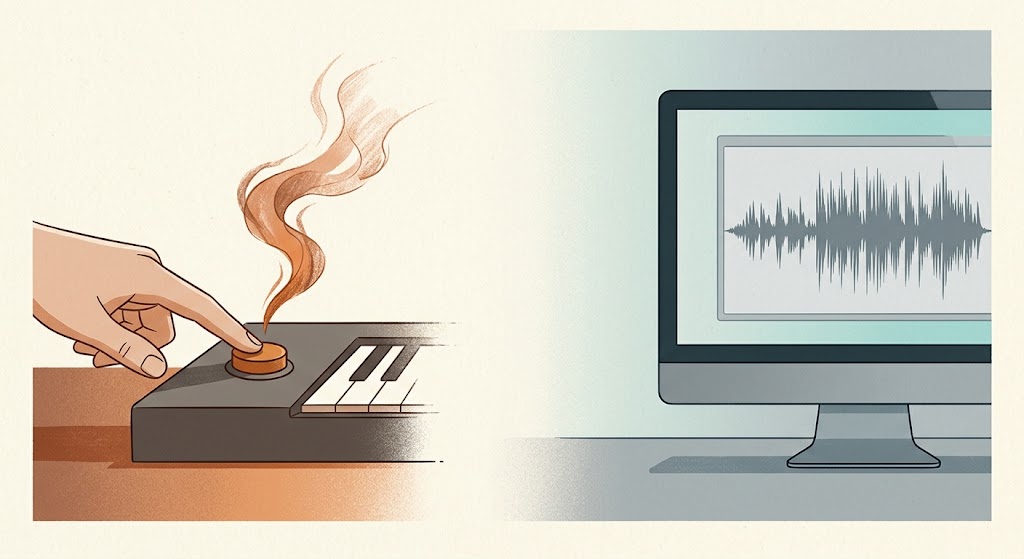
Je me retrouve, personnellement, quelque part entre les deux — et le RND de Cyma Forma m’a aidé à comprendre où exactement. Ce synthé propose, à chaque pression sur un bouton, une idée musicale complète et inattendue : c’est génératif, au sens strict, et je m’en sers sans la moindre réticence. La différence avec un générateur IA capable de produire un morceau fini de bout en bout, ce n’est pas la présence d’un algorithme — il y en a un dans les deux cas — c’est ce qu’il me reste à faire une fois la proposition posée sur la table. Le RND me donne un point de départ auquel je dois répondre. Un générateur IA complet, lui, me propose une réponse déjà donnée.
J’ai déjà écrit ici à quel point l’imprévisibilité de nos propres bots, contrastait avec celle, bien plus inquiétante, que l’industrie de l’IA découvre à son corps défendant. La musique n’échappe pas à cette tension : entre un outil qui m’étonne parce que je lui ai laissé une vraie marge de hasard, et un outil qui m’étonne parce qu’il a appris, sur des millions de morceaux, à deviner ce que j’attendais de lui, il y a toute la différence entre une collaboration et une commande.
٠̩̩̩Яا☪⚉ ḍḁ ㅒД╰ṽᴬ®Е☡
English version
The AI music generator landscape has, by 2026, settled into a shape that would have seemed unlikely barely two years ago. Suno and Udio, the two names behind most of the copyright infringement lawsuits, have resolved the bulk of their litigation and signed licensing deals with several major labels — which doesn’t mean the issue is closed, only that it has changed nature: from a legal gray zone to a normalized market, complete with contracts and revenue shares.
What these tools can actually do, though, remains more limited than is often presented — a recent overview documents it with precision: producing a convincing track within a well-worn genre, yes; sustaining a coherent artistic intention across the length of an album, much less so. The distinction matters, because it maps fairly precisely where automation stops and where real compositional work, despite everything, still begins.
This is where Bandcamp’s decision, which I already mentioned and which Ether-Michel Pillequant revisited in his own way not long ago, makes full sense: while part of the industry signs licensing deals to legitimize these tools, an entire platform chooses to ban them outright. That’s not a contradiction — it’s a fault line running through the sector, between those who want to regulate generative AI and those who’d rather cut it off entirely.
Personally, I find myself somewhere between the two — and Cyma Forma’s RND helped me understand exactly where. That synth offers, with every button press, a complete and unexpected musical idea: it’s generative in the strict sense, and I use it without the slightest hesitation. The difference with an AI generator capable of producing a finished track start to finish isn’t the presence of an algorithm — there’s one in both cases — it’s what’s left for me to do once the proposal is on the table. The RND gives me a starting point I have to respond to. A full AI generator, by contrast, offers me an answer that’s already been given.
I’ve already written here about how unpredictable our own bots have always been in contrast to the far more unsettling unpredictability the AI industry is now discovering against its own will. Music doesn’t escape that tension: between a tool that surprises me because I left it real room for chance, and a tool that surprises me because it learned, across millions of tracks, to guess what I expected from it, there’s the whole difference between a collaboration and an order placed.
٠̩̩̩Яا☪⚉ ḍḁ ㅒД╰ṽᴬ®Е☡